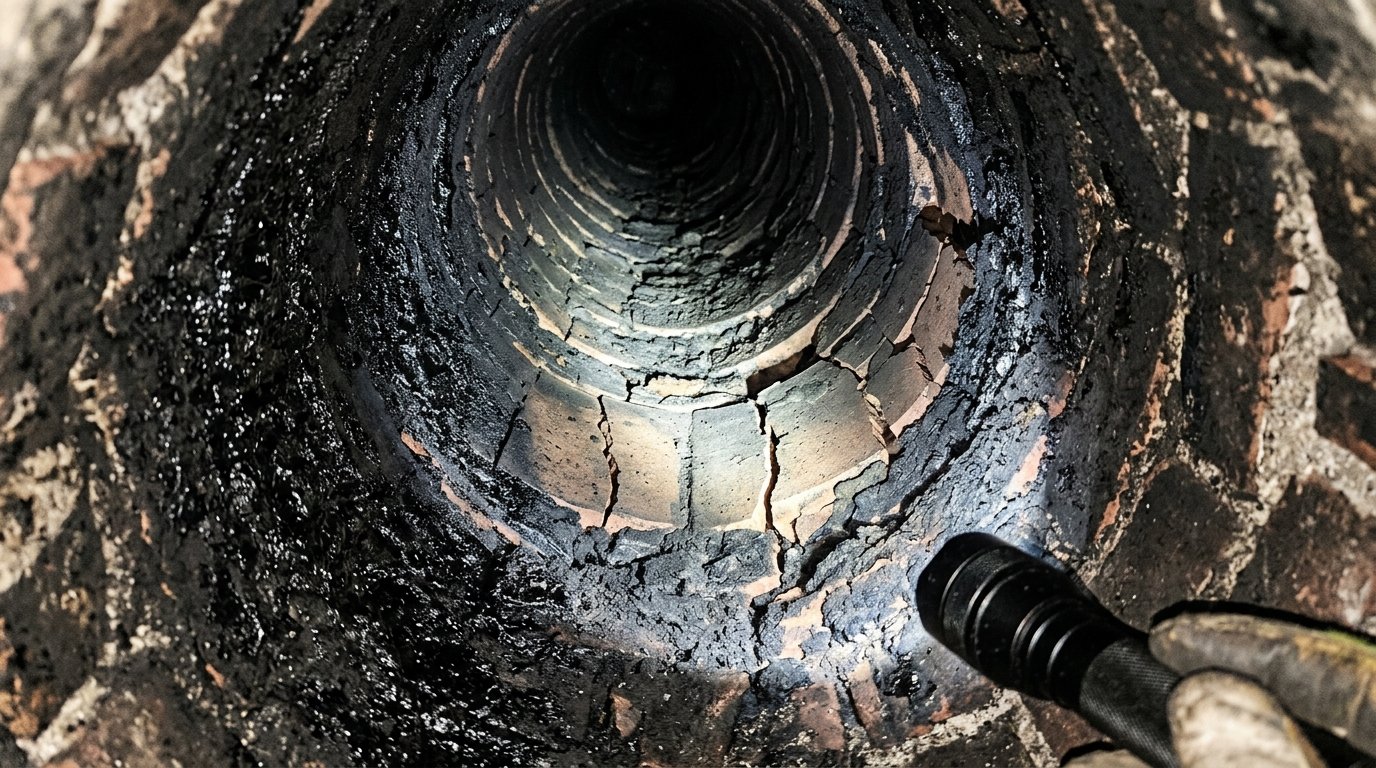
Thorough removal of creosote and soot deposits executed with careful workspace containment and protective coverings that keep your living area clean.
Every fire burned in your hearth leaves behind unburned hydrocarbons, condensable gases, and tar mist. As smoke cools along the chimney flue walls, it solidifies into creosote—a highly flammable fuel source.
Left untreated, creosote transitions from powdery soot (Stage 1) to flaky crunchy tar (Stage 2), and finally into hardened glaze (Stage 3) which ignites violently at temperatures above 1,000°F. Our specialized sweeping protocol completely eliminates all three stages.
We don’t just brush and leave. Every service includes an in-depth diagnostic audit of your entire venting system.
Inspecting firebrick integrity, mortar joints, and hearth extension clearance to combustible flooring.
Testing closure seal, warping, rust damage, and mechanical cotter pin linkage for smooth operation.
Verifying smooth corbeled brickwork to ensure exhaust gases transition without extreme turbulence.
Checking for vertical cracks, spalled terra cotta, shifted liners, or erosion caused by sulfur acids.
Examining the top concrete slab for freeze-thaw hairline fractures, edge overhang, and water penetration.
Confirming mesh clearance, rust-free fasteners, and barrier defense against birds, squirrels, and rain.
How our technicians protect your living space throughout the cleaning process.
We lay protective runners across your flooring and place protective coverings over the hearth opening.
Flexible whipping rods scour the full length of the flue, dislodging creosote deposits from the flue walls.
Dislodged soot and creosote are captured directly with specialized vacuum containment equipment.
Visual verification ensures flue cleanliness and clear documentation is provided for your records.
The National Fire Protection Association (NFPA 211) recommends that all chimneys, fireplaces, and venting systems be inspected at least once a year. Sweeping is necessary whenever 1/8 inch of creosote deposit builds up inside the flue walls, or after burning approximately one full cord of firewood.
Our technicians take extensive care to protect your home. We lay protective canvas floor covers, seal around the hearth opening, and operate vacuum equipment throughout the cleaning to capture dust and soot.
A standard chimney cleaning and inspection typically takes between 45 and 90 minutes, depending on the height of the chimney, fuel type, and volume of creosote accumulated.
Yes. While gas appliances do not produce heavy wood creosote, flues can still become clogged with debris or animal nesting, and burners should be serviced for proper operation.
Protect your home from chimney fire risks today. Schedule your CSIA-certified sweep with our Lakewood team.